MyBatis 3 User Guide & Visual Documentation Suite
Welcome to the unofficial visual documentation and engineering suite for MyBatis 3 (v3.6.0)—the premier SQL-first persistence framework for Java—built with PNI501 and Drawlib.
Unlike monolithic Object-Relational Mappers (ORMs) that hide SQL behind opaque object-graph query languages, MyBatis couples Java methods directly to hand-crafted SQL statements via XML or Java annotations, while eliminating nearly 100% of raw JDBC PreparedStatement binding and ResultSet extraction boilerplate.
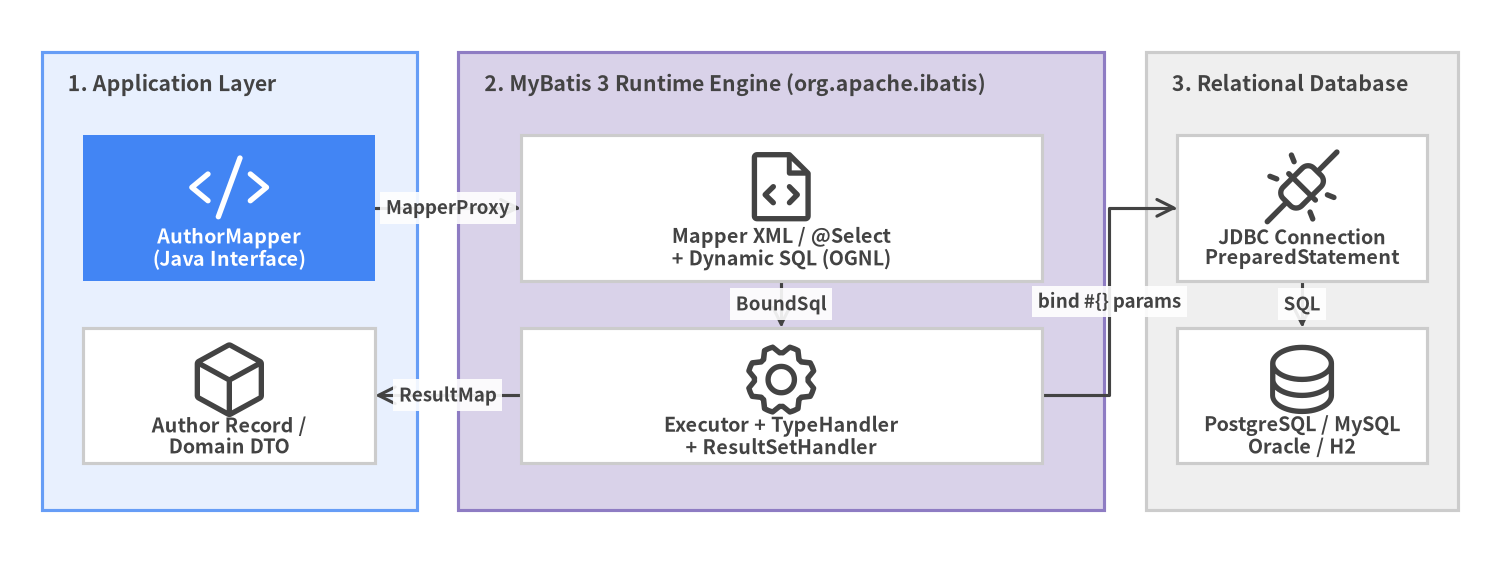
Source Code
from drawlib.canvas import save, setup
from drawlib.diagrams.architecture import ArchitectureDiagram, Node, NodeGroup, PhosphorIcon
from drawlib.styles import Colors, Styles

setup(width=144, height=54, dpi=150)

d = ArchitectureDiagram(
    node_style=Styles.Dark,
    node_text_style=Styles.DarkBold.patch(text_size=9.5),
    edge_style=Styles.Dark.patch(line_width=1.5),
    edge_text_style=Styles.DarkBold.patch(text_size=9.0),
    node_card_style=Styles.Neutral.patch(shape_fill_color=Colors.White),
)

app = d.add(
    NodeGroup(
        "1. Application Layer",
        width=36,
        height=44,
        style=Styles.PrimaryNeutral,
        text_style=Styles.DarkBold.patch(text_size=10.2, halign="left", valign="top"),
    ),
    xy=(4, 5),
)
n_if = app.add(
    Node(
        "AuthorMapper\n(Java Interface)",
        icon=PhosphorIcon.CODE,
        width=28,
        height=14,
        style=Styles.White,
        text_style=Styles.WhiteBold.patch(text_size=9.5),
        card_style=Styles.PrimaryFlat,
    ),
    xy=(18, 29),
)
n_rec = app.add(Node("Author Record /\nDomain DTO", icon=PhosphorIcon.CUBE, width=28, height=13), xy=(18, 11))

core = d.add(
    NodeGroup(
        "2. MyBatis 3 Runtime Engine (org.apache.ibatis)",
        width=62,
        height=44,
        style=Styles.SecondaryNeutral,
        text_style=Styles.DarkBold.patch(text_size=10.2, halign="left", valign="top"),
    ),
    xy=(44, 5),
)
n_xml = core.add(Node("Mapper XML / @Select\n+ Dynamic SQL (OGNL)", icon=PhosphorIcon.FILE_CODE, width=50, height=14), xy=(31, 29))
n_exe = core.add(Node("Executor + TypeHandler\n+ ResultSetHandler", icon=PhosphorIcon.GEAR, width=50, height=13), xy=(31, 11))

db = d.add(
    NodeGroup(
        "3. Relational Database",
        width=30,
        height=44,
        style=Styles.Neutral,
        text_style=Styles.DarkBold.patch(text_size=10.2, halign="left", valign="top"),
    ),
    xy=(110, 5),
)
n_jdbc = db.add(Node("JDBC Connection\nPreparedStatement", icon=PhosphorIcon.PLUGS_CONNECTED, width=24, height=14), xy=(15, 29))
n_sql = db.add(Node("PostgreSQL / MySQL\nOracle / H2", icon=PhosphorIcon.DATABASE, width=24, height=13), xy=(15, 11))

n_if.connect(n_xml, label="MapperProxy")
n_xml.connect(n_exe, label="BoundSql")
n_exe.connect(n_jdbc, label="bind #{} params")
n_jdbc.connect(n_sql, label="SQL")
n_exe.connect(n_rec, label="ResultMap")

d.draw(xy=(0, 0))
save()
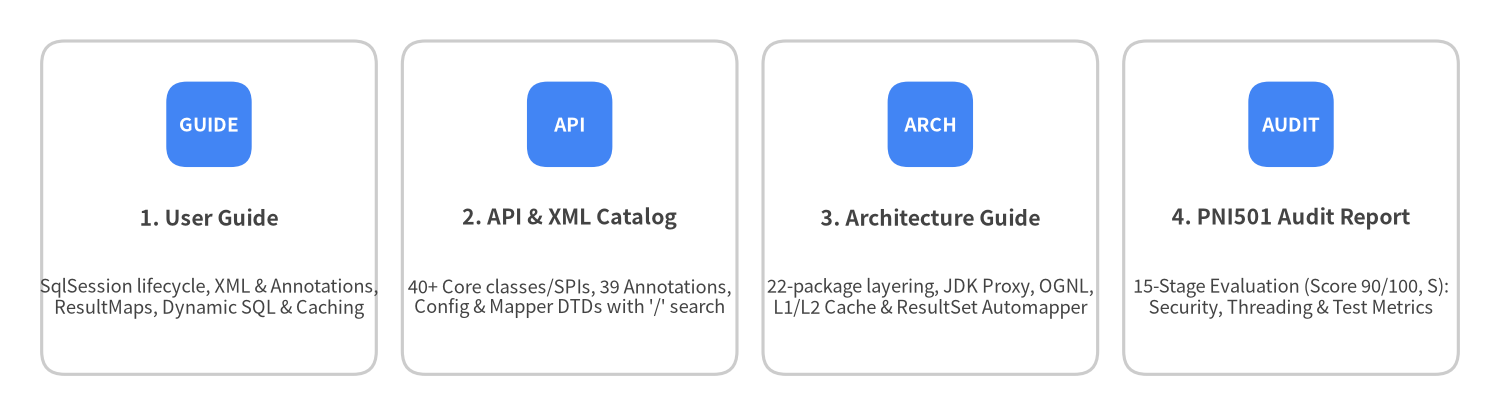
Explore the 4-Portal Documentation Suite
This site is organized into four interconnected portals covering usage, reference, internals, and quality diagnostics:
| Portal | Scope & Audience | URL |
|---|---|---|
| 1. User Guide (Current Portal) | Practical tutorials, XML & Annotation patterns, Dynamic SQL, <resultMap>, caching, transactions, and plugins |
/ |
| 2. API & XML Reference Catalog | Searchable / reference for every public Java class, interface, annotation, and XML DTD element |
/api/ |
| 3. Internal Architecture Guide | Source-level deep dive into MapperProxy, CachingExecutor, DynamicSqlSource, and DefaultResultSetHandler |
/architecture/ |
| 4. PNI501 Diagnostic Report | 15-stage automated & expert architecture audit (90/100, Grade S) in HTML & printable PDF |
/reports/pni501/ |
Source Code
from drawlib.canvas import save, setup
from drawlib.smartarts import CardList
from drawlib.styles import Colors, Styles

setup(width=144, height=40, dpi=150)

cards = CardList(
    style=Styles.Neutral.patch(shape_fill_color=Colors.White),
    text_style=Styles.DarkBold.patch(text_size=10.2),
    description_style=Styles.Dark.patch(text_size=8.8),
    badge_shape="rounded_rect",
    badge_style=Styles.PrimaryFlat,
    badge_text_style=Styles.WhiteBold.patch(text_size=9.2),
    direction="horizontal",
    spacing=2.5,
)

cards.add(
    "1. User Guide",
    "SqlSession lifecycle, XML & Annotations,\nResultMaps, Dynamic SQL & Caching",
    badge_text="GUIDE",
)
cards.add(
    "2. API & XML Catalog",
    "40+ Core classes/SPIs, 39 Annotations,\nConfig & Mapper DTDs with '/' search",
    badge_text="API",
)
cards.add(
    "3. Architecture Guide",
    "22-package layering, JDK Proxy, OGNL,\nL1/L2 Cache & ResultSet Automapper",
    badge_text="ARCH",
)
cards.add(
    "4. PNI501 Audit Report",
    "15-Stage Evaluation (Score 90/100, S):\nSecurity, Threading & Test Metrics",
    badge_text="AUDIT",
)

cards.draw((4.0, 4.0), width=136.0, height=32.0, align="bottom_left")
save()
60-Second Quickstart
1. Add Maven Dependency
<dependency>
  <groupId>org.mybatis</groupId>
  <artifactId>mybatis</artifactId>
  <version>3.6.0</version>
</dependency>
2. Define a Java Record & Mapper Interface
MyBatis 3 natively maps SQL columns directly into immutable Java record canonical constructors:
package com.example.blog;

import java.time.LocalDateTime;
import java.util.List;
import org.apache.ibatis.annotations.Insert;
import org.apache.ibatis.annotations.Options;
import org.apache.ibatis.annotations.Param;
import org.apache.ibatis.annotations.Select;

public record Author(Long id, String username, String email, LocalDateTime createdAt) {}

public interface AuthorMapper {

  @Select("""
      SELECT id, username, email, created_at AS createdAt
      FROM authors
      WHERE id = #{id}
      """)
  Author findById(@Param("id") long id);

  @Select("""
      SELECT id, username, email, created_at AS createdAt
      FROM authors
      WHERE username LIKE #{pattern}
      ORDER BY id ASC
      """)
  List<Author> searchByUsername(@Param("pattern") String pattern);
}
3. Bootstrap SqlSessionFactory and Execute Queries
Build SqlSessionFactory once at application startup, then open short-lived SqlSession instances inside try-with-resources blocks per request:
import javax.sql.DataSource;
import org.apache.ibatis.mapping.Environment;
import org.apache.ibatis.session.Configuration;
import org.apache.ibatis.session.SqlSession;
import org.apache.ibatis.session.SqlSessionFactory;
import org.apache.ibatis.session.SqlSessionFactoryBuilder;
import org.apache.ibatis.transaction.jdbc.JdbcTransactionFactory;

// 1. Application-scoped singleton initialization
DataSource dataSource = createHikariDataSource();
Environment environment = new Environment("prod", new JdbcTransactionFactory(), dataSource);

Configuration config = new Configuration(environment);
config.setMapUnderscoreToCamelCase(true); // Maps created_at -> createdAt automatically
config.addMapper(AuthorMapper.class);

SqlSessionFactory sessionFactory = new SqlSessionFactoryBuilder().build(config);

// 2. Per-request execution using try-with-resources
try (SqlSession session = sessionFactory.openSession()) {
  AuthorMapper mapper = session.getMapper(AuthorMapper.class);
  Author author = mapper.findById(42L);
  System.out.println("Loaded author: " + author);
}
Chapter Roadmap
- 1. Installation & SqlSession Lifecycle: Maven/Gradle setup,
SqlSessionFactoryBuilder->SqlSessionFactory->SqlSession->Mapperthread-safety rules, andtry-with-resources. - 2. XML Configuration (
mybatis-config.xml): Ordering of<configuration>elements, essential<settings>(mapUnderscoreToCamelCase,localCacheScope,defaultFetchSize),<typeAliases>, and<environments>. - 3. Mapper XML & SQL Statements:
<select>,<insert>,<update>,<delete>, auto-generated keys (useGeneratedKeys="true"&<selectKey>),#{}PreparedStatement binding vs${}string substitution, and reusable<sql>fragments. - 4. ResultMaps, Records & Associations:
<resultMap>, immutable Javarecord<constructor>mapping,1:1<association>,1:N<collection>, and avoiding the N+1 query pitfall with JOIN result maps. - 5. Dynamic SQL & OGNL Tags:
<if>,<choose>/<when>/<otherwise>,<where>,<set>,<trim>,<foreach>batch &IN (...)clauses, and<bind>. - 6. Java Annotations & SQL Builder:
@Select,@Results,@Arg,@One/@Many, and dynamic providers (@SelectProvider+org.apache.ibatis.jdbc.SQL). - 7. L1/L2 Caching, Transactions & Batching: L1 session cache (
localCacheScope), L2 namespace<cache>,jdk.serialFiltersecurity,ExecutorType.BATCH, andCursor<T>streaming. - 8. TypeHandlers, Plugins & Testing: Custom
BaseTypeHandler<T>,@Interceptsplugins onExecutor/StatementHandler, and integration testing withScriptRunner.